K2-18b, detected in 2015, orbits a star 124 light years away. Though it is over 800% as large as Earth, its space in the habitable zone of its star, like where we are, means the possibiliy that liquid water could exist on its surface.
The science community calls it The Goldilocks Zone. Like the character in the children's story who wanted porridge neither too hot nor too cold, a Goldilocks planet that might have life we could recognize would need to be in a similar narrow band.
In 2023, the James Webb Space Telescope looked at K2-18b’s atmosphere from 124 years ago in near-infrared light and found what could be an extremely weak signal of a molecule called dimethyl sulphide, which on earth is mainly produced by marine phytoplankton. So they looked again, with the mid-infrared camera and found a stronger signal for dimethyl sulphide
and possibly dimethyl disulphide, which is also produced only by living organisms on Earth.
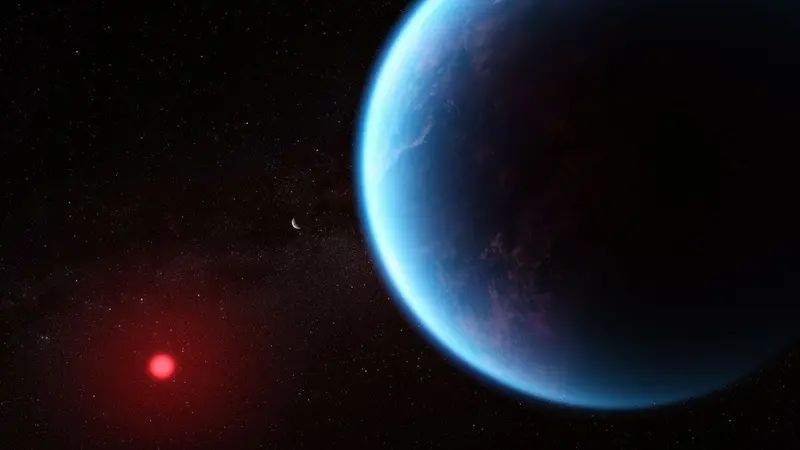
It's a picture, not science. Credit:
NASA, ESA, CSA, Joseph Olmsted.
Media and the more hyperbolic fringes of social media declared life on other planets and NASA does not mind. They could practically trademark "implications for life on other planets" because they use it in their press releases so often, but this isn' the first false alarm about K2-18b and there is no real evidence outside a statistical blips that the two molecular signatures are present at all.
"Any claim of possible signature of life beyond Earth needs to be verified by other experts analyzing both the same data and hopefully better data sets in the future. However, these new results are certainly worth a closer look,” notes Virginia Tech astrophysics Professor Nahum Arav.