Due to the rising costs and inability of doctors to own hospitals since the Affordable Care Act (ACA), costs have ballooned. The ACA was passed because 750,000 people had pre-existing conditions that made private insurance unavailable, yet their incomes were too high for government assistance. The ACA bridged that gap, yet as government requirements increased the cost for everyone increased so much that 50,000,000 now need subsidies.
Hospitals are so expensive that a new paper is justification for bringing back 'house calls' - where doctors would visit the home. In the distant past, it was common, but more recently the cost and hassle of that was unmanageable for any but the most wealthy. Yet states like California, with new high minimum wage mandates regardless of where the health care is located, have gutted rural clinics. Over $5 billion in rural clinics have gone out of business in just that state due to inability to charge rural people enough to cover the other government costs.
And over 20 percent of America lives in rural areas. Rural clinics are one problem, but 150 rural hospitals have also shuttered due to higher costs of Affordable Care.
Yet doctors and nurses can still help patients even without being allowed to open hospitals. By driving to where the patients are. A randomized controlled trial assigned patients to either traditional hospital care or home medical services, where they had in-home visits with nurses twice per day and a daily remote video conference with a physician. The 161 adults had conditions like asthma, chronic obstructive pulmonary disease, heart failure, and infections.
Thanks to modern technology, the old telemetry system is now a sticker on the chest and intravenous infusion can be done using a pump so small it fits in a purse, the cost for equipment remained low. Not only was sending health care personnel to homes rather than keeping patients in hospitals not more expensive, it was 27% less costly. There was no safety issue, readmission rates for at-home care and hospitals were the same.
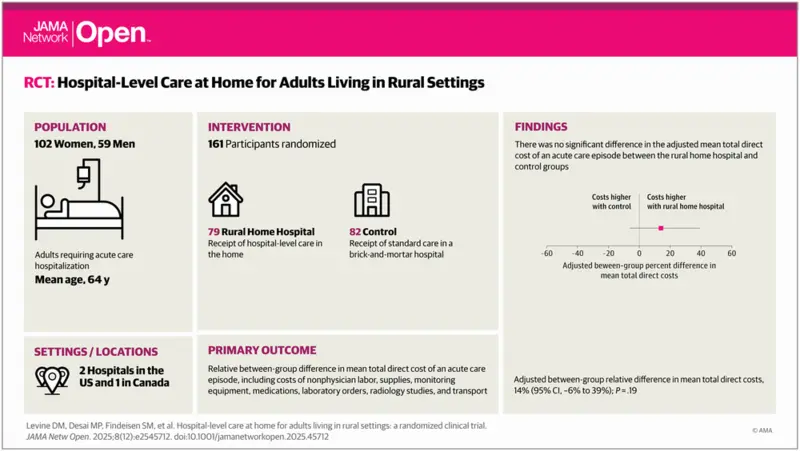
Patients were both happier, nearly twice as happy with their care as hospital admissions, and far less sedentary than in hospitals, where they want you staying in bed.
There remain political challenges. States like California, which mandate the same high-cost solution for both urban Los Angeles and rural Markleeville, will drive mobile clinics out of existence within months, but states with more evidence-based thinking could implement in-home care for rural residents without the paperwork and inevitable lawsuits that states on the coasts mean.
Citation: Levine DM, Desai MP, Findeisen SM, et al. Hospital-Level Care at Home for Adults Living in Rural Settings: A Randomized Clinical Trial. JAMA Netw Open. 2025;8(12):e2545712. https://jamanetwork.com/journals/jamanetworkopen/fullarticle/2842110 doi:10.1001/jamanetworkopen.2025.45712