Starting tonight, and lasting until Thanksgiving, Earth has a second moon.
Our Mini Me is named 2024 PT5, an Arjuna asteroid discovered on August 7th of this year by the Asteroid Terrestrial-impact Last Alert System. Arjuna asteroids are defined as small objects "moving in orbits with low eccentricity, low inclination and Earth-like period.” These mini moons occur when an asteroid moving at low velocity gets stuck in a horseshoe pattern because it has low geocentric energy but doesn't complete a revolution around our planet while it is there. Calculatioms show 2024 PT5 rwill return to a heliocentric path 56.6 days later.
They are more common than most realize. 2022 NX1 was a mini-moon in 2022, and also in 1981. 2024 PT5 usually orbits the sun, and once the sun exerts its pull again that is its future trajectory again.
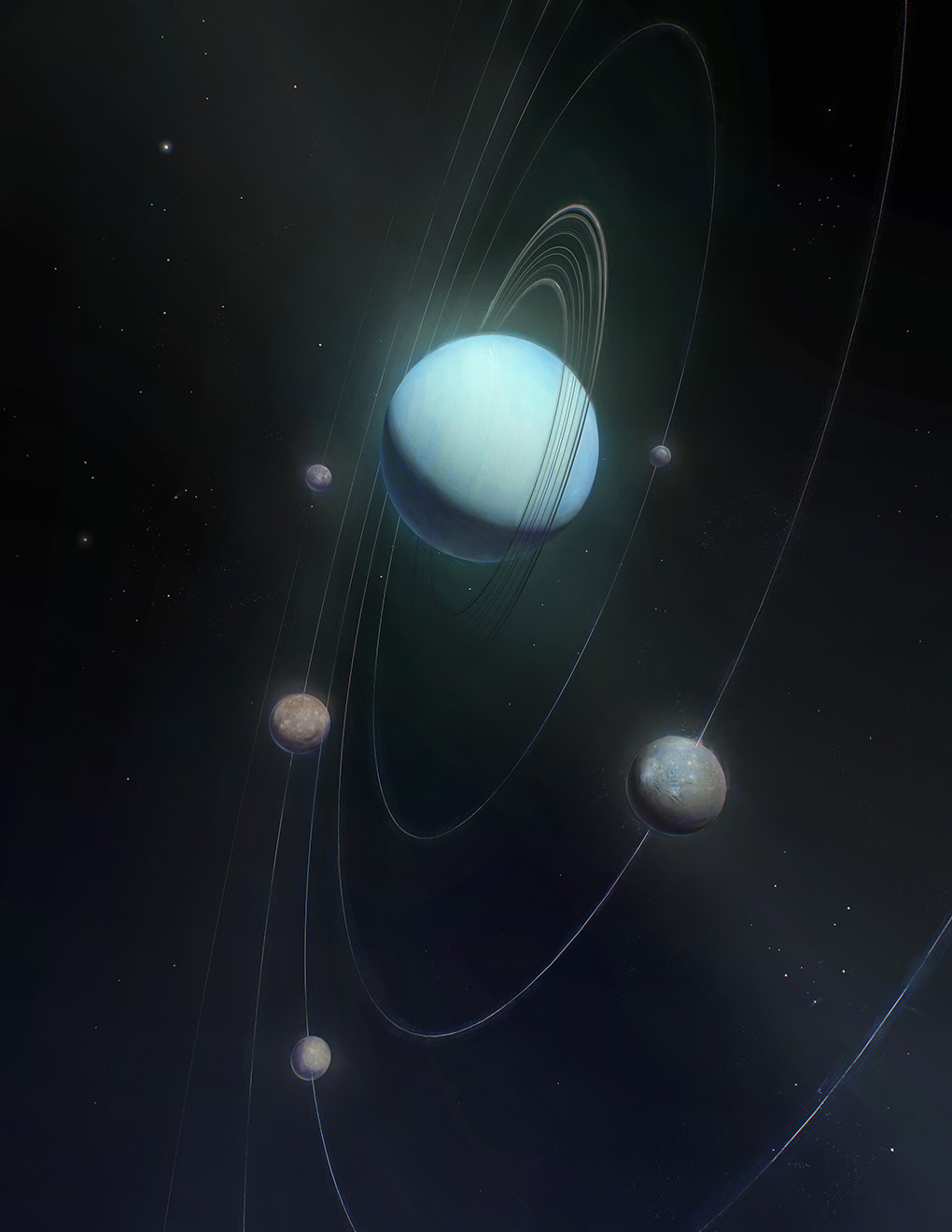
Uranus has multiple moons. For 56 days, we'll be in the planetary big leagues. Graphical representation of Uranus orbited by Miranda, Ariel, Umbriel, Titania and Oberon by NASA/Johns Hopkins APL/Mike Yakovlev
How can you see our mini-moon?
Seeing our mini-moon is a little trickier than the Perseids or something else that casual astronomers view. You won't be able to see this with just your eyes, binoculars, or even home telescopes. To capture this little guy you will need a 30-inch telescope plus a charge coupled device (CCD) or Complementary Metal Oxide Semiconductor (CMOS) sensor. They are both common in cameras now because affordable CMOS began to catch up to CCD about 20 years ago, and my Canon EOS has a good one for most applications but more serious photographers will have something like a ZWO ASI183MM Pro. I have the camera but lack the telescope, so I will drive to a friend's closer to the Sierra Nevada mountains and try not to make a mockery with my results.
If you get a chance to see it, take the opportunity. Otherwise you will have to wait until 2055.