I once was an active chessplayer, but work duties have long taken tournaments off my plate - I simply do not have the time to sit through long hours of chess battles. So I play blitz online on chess.com (my handle is "tommasodorigo", in case you wondered). Most of the time this is a rather dull way to spend my time, and yet, now and then, the occupation brings me pleasure.
That happens when I manage to calculate deeper than usual and correctly evaluate unbalanced positions that end up in my favor. Like in the game I played today. After some innocuous opening moves and an inaccuracy by my opponent (some "Avbuk", here playing the black pieces) we got to the following position:
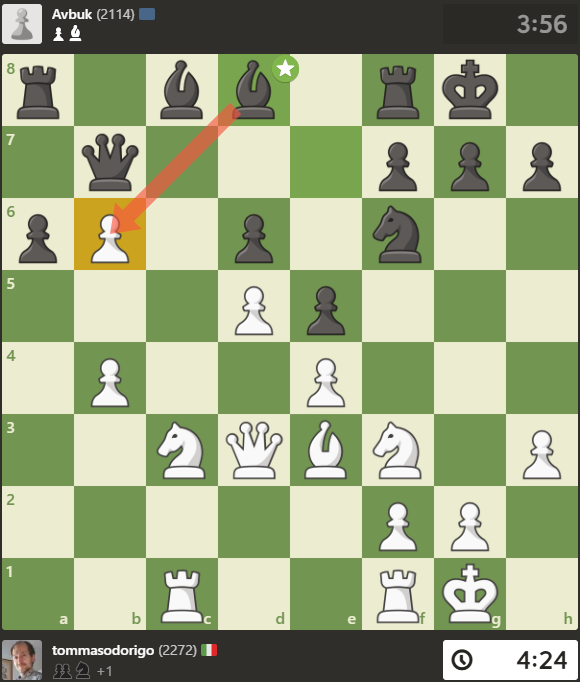
As you can see I am up a pawn, but black figured he would soon cash it in, with the last move (Bd8) ready to snatch it. But I had seen much further than that, and the game continued exactly as I had foreseen. Can you see the sequence by which white sacrifices a whole rook to get an overwhelming pawn storm going?
I played 18.Na4!, to which the natural 18...Bd7 was met with the brilliant...
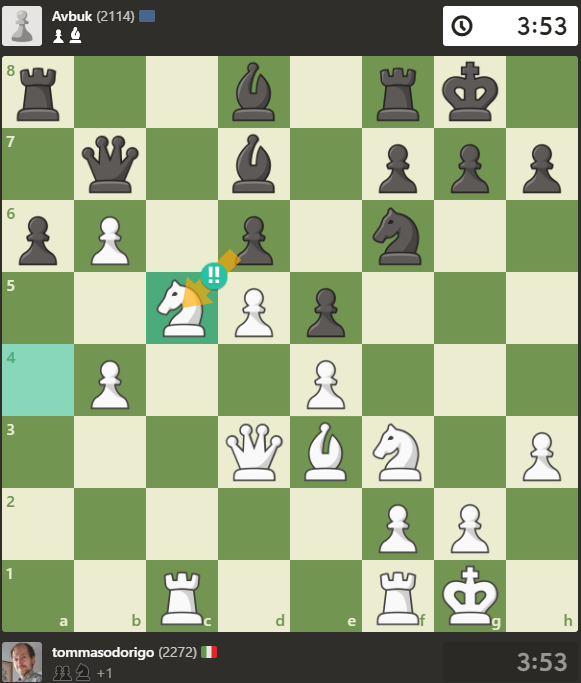
19.Nc5!!
After you see it on the board this move appears obvious: in exchange for a mere knight white gets a strong phalanx of passed pawns on the queenside. However, you need to have seen further - white will have to concede an exchange in addition, the Rf1, to stabilize the position. The game continued 19....dxc5 (other moves are no better) 20.bxc5 Bb5. Uh, oh! White will lose an exchange now. Is the position still better for him? Yes, it is won anyway! After 21.Qb1 Bxf1,
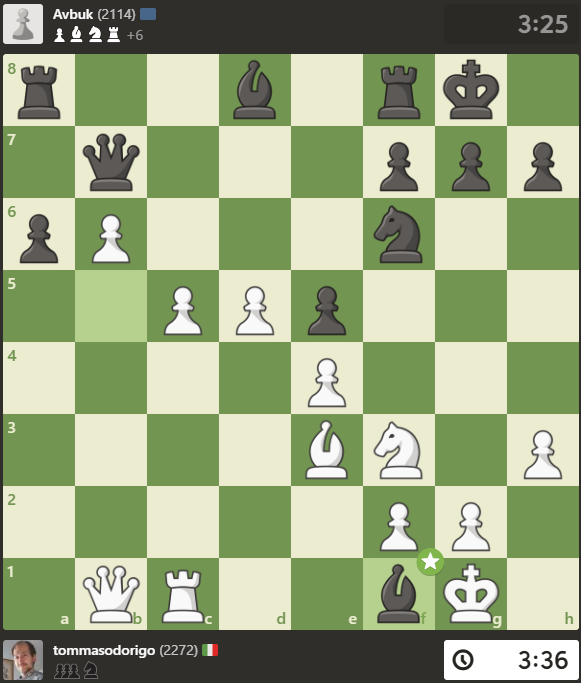
white has the strong intermediate 22.c6! Black continued 22....Qb8 23.Kxf1 Be7and after 24.b7 Bd6 25.bxa8=Q Qxa8 26.Qb7
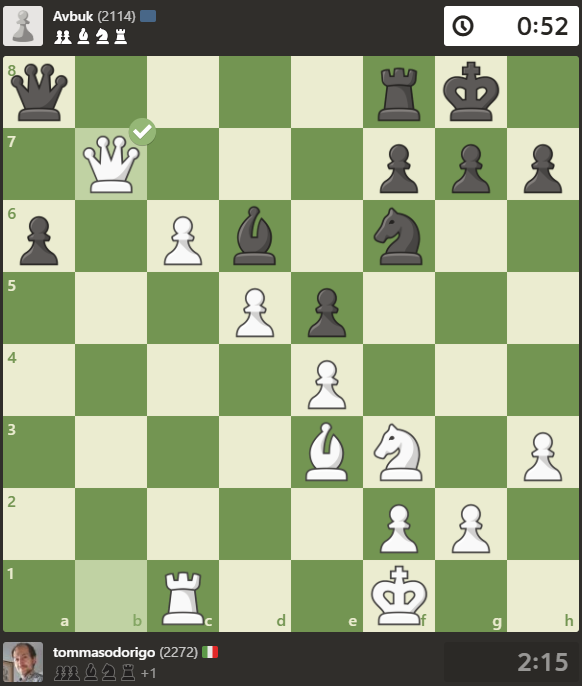
I eventually won back the rook, retaining my advantage and quickly converted to a win.