For decades, natural history books have taught that when a
catastrophic asteroid struck Earth 66 million years ago, it wiped out the
dinosaurs and gave mammals – until then mostly small, tree-dwelling creatures –
a chance to flourish on the ground.
It’s the classic “mammals rise after dinosaurs fall” narrative.
Now new research is complicating that story. A study
published this week in Palaeontology
reveals that many mammals were already swapping the treetops for life on the
ground before the dino-killing asteroid hit. In other words, the shift from arboreal
(tree-dwelling) to terrestrial (ground-dwelling) was well underway while
dinosaurs still roamed. Mammals weren’t just passive little critters waiting
for their moment – they were actively adapting to a changing world.
Fossil Clues to an Early Transition
A team led by Professor Christine Janis at the University of
Bristol found clues in an unlikely source: tiny fossilized limb bone fragments
from the Late Cretaceous. These fossils came from western North America – the
only region with a well-preserved fossil record of Late Cretaceous mammals –
and consisted of mere limb-end fragments.
Yet these little bits of bone hold big information. The joint surface at a
bone’s end – the articular surface – reveals how an animal moved. By
examining these joint surfaces, Janis and colleagues inferred whether each
species was adapted for climbing in branches or running on the ground.
Complete skeletons are rare, but even fragments can tell the
tale. “We’ve known for a long time that mammalian long bone articular surfaces
can carry good information about their mode of locomotion,” Janis notes, “but I
think this is the first study to use such small bone elements to study change
within a community, rather than just individual species.” By piecing together many small
fossils, the team tracked an entire community’s shift in lifestyle. Comparing
the fossil joints with modern mammals helped confirm each species’ habits.
Many therian mammals – ancestors of today’s placentals and
marsupials – were already coming down from the trees in the Late Cretaceous, millions
of years before the asteroid impact.
Janis notes that “tree dwelling mammals struggled after the asteroid impact,”
but her team’s findings show some mammals had embraced ground living well before
that cataclysm. These little pioneers likely scurried beneath the feet of
dinosaurs like T. rex, foraging in the underbrush as those giants
thundered above.
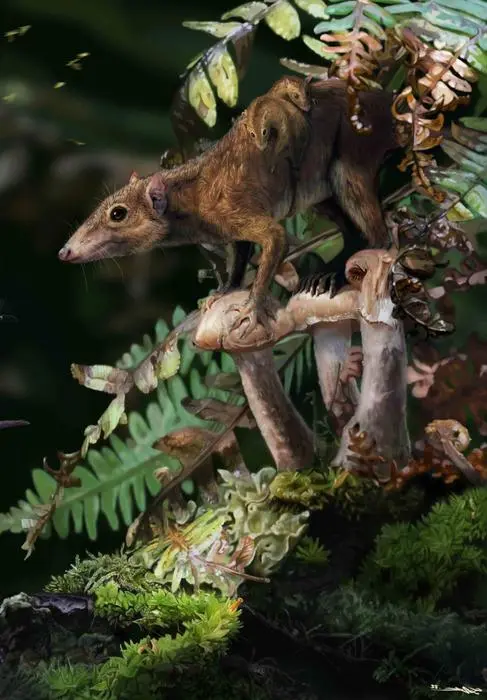
An artist’s depiction of a small Mesozoic mammal (Dryolestes) in its forest habitat. By the Late Cretaceous, many mammals like these had begun moving from the trees to the ground, taking advantage of new niches on the forest floor. (Artist: James Brown, courtesy of Pamela Gill) For these ground-bound pioneers, a fern- and flower-filled forest floor was home sweet home.
Flowering Plants Changed the Landscape
So what drove this early move to the ground, if not the
disappearance of dinosaurs? The answer lies in Late Cretaceous vegetation.
Around the same time, Earth’s plant life was going through a revolution.
Flowering plants – known as angiosperms – were diversifying and spreading,
transforming ecosystems once dominated by conifers and ferns. “It was already
known that plant life changed toward the end of the Cretaceous, with flowering
plants… creating more diverse habitats on the ground,” Janis notes. Flowers, fruits, and
broad-leaved plants now carpeted the ground, providing new food sources and
hiding places.
Scientists suspected mammals took advantage of this
botanical boom, and the fossils confirm that hunch: mammals were indeed
becoming more terrestrial “in line with the habitat changes” brought by
flowering plants. With
more food and cover at ground level, some mammals thrived below the canopy even
as dinosaurs still dominated above.
This research suggests that vegetation change – not just
dinosaur competition – guided mammalian evolution. “The vegetational habitat
was more important for the course of Cretaceous mammalian evolution than any
influence from dinosaurs,” Janis emphasizes.
Mammals weren’t simply cowering in trees waiting for their chance – they were
already adapting to a changing world of plants.
Rethinking Mammals’ Big Break
The finding that many mammals were ground-dwellers before
the asteroid strike reshapes a key chapter of evolution. It suggests the
mammalian takeover wasn’t a sudden sprint after the dinosaurs bowed out, but a gradual
marathon already in progress while dinosaurs were still around. Mammals were
already securing a foothold on the ground thanks to niches created by flowering
plants. So when the asteroid struck and dinosaurs perished, ground-ready
mammals had a head start in the post-extinction world.
This more nuanced view highlights the complex interplay of
factors that drive evolution. Mass extinctions are dramatic, but they aren’t
the only authors of evolutionary success. Mammals were not just lucky
beneficiaries of the dinosaurs’ demise – they were also innovators responding
to Earth’s changing flora.
Reframing the story gives credit to the quiet evolutionary
experiments that paved the way for mammals’ success. The new fossil analysis
offers “fresh evidence”of
how mammals responded to shifting environments in the Late Cretaceous. It
underscores that the groundwork for the Age of Mammals was being laid even as
dinosaurs thundered across the land.