If you've ever tried to use a dating app, you may think asexual reproduction would be better than seeing someone 15 years older than their photo arrive at the restaurant but from an evolutionary perspective, it wasn't quite a dead end, but it was a slow crawl.
A new study of fossils from about 575 million years ago, the oldest known animals so far, may explain why animal life appeared but barely evolved over millions of years.
Prior to animal life showing up on the scene, microbiology ruled the planet. Then somewhere after 639 million years ago, animals appeared - and some, like Fractofusus, could be tall. But you'd think they were plants. No mouths, no movement, they absorbed nutrients - and they only reproduced asexually, using clones. They lasted a long time, 1,000 times as long as humans have, but eventually died off during the Cambrian period.
The authors of the new work believe that asexual, stolon-based reproduction limited dispersion whereas the later shift to sexual reproduction coincided with a sudden burst of evolutionary diversity.
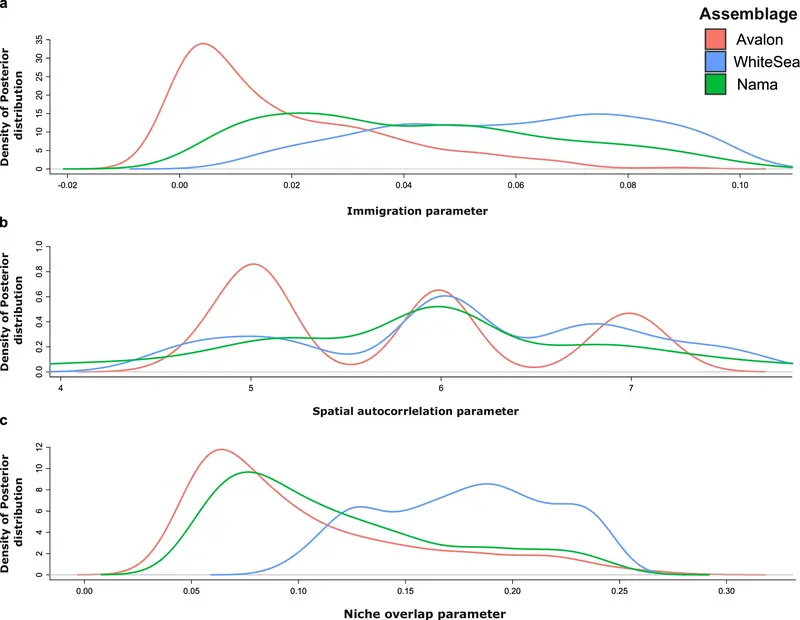
a) shows increasing immigration (although still low) between the Avalon and White Sea assemblages, with medium values for Nama. b) Shows the three discreet values for spatial autocorrelation (5, 6, and 7), with the Avalon showing a clear distinction of low spatial autocorrelation, with more similar values for the White Sea and Nama assemblages. c) shows high levels of niche overlap for the Avalon with medium to low niche overlap for the White Sea assemblage. Nama assemblage shows lower, but similar levels of niche overlap to the Avalon assemblage.
That's right, lack of sex limited the animal kingdom. It has limits but competition for mates optimizes species. Sharing nutrients sounds nice but it's a biological dead end. Only when life in the Ediacaran spread from the deep ocean to shallow waters did nature get more challening; with tides, storms, and changing temperatures making life more precarious, which led to survival of the fitter. Sitting in the water passively absorbing food is a much different animal than ones that are killing each other for food. Sexual reproduction can be linked to that competition and evolutionary pressure.
Citation: Emily G. Mitchell and Andrea Manica. 'The influence of reproductive mode on resource competition and diversity patterns in Ediacaran early animal communities', Nature Ecology and Evolution (2026).