Hepatectomy is surgery in which part of the liver is removed, generally to treat liver cancer or harvest a portion of the liver for a transplant.
An EXPLORATORY study in mice found that a supplement of beta-hydroxy-beta-methylbutyrate helped their organ recover more quickly and was resistant to further damage.
Beta-hydroxy-beta-methylbutyrate is a metabolite derived from leucine, an amino acid. About 5 percent of ingested leucine is converted into beta-hydroxy-beta-methylbutyrate in the liver. In illness or cases of preserving muscle mass, supplementation is used.
The mice received a daily dose of beta-hydroxy-beta-methylbutyrate equivalent to human doses for 10 days. Then approximately 70% of the animals’ livers were removed, a classic model for studying liver resection and regeneration. Under a new stress scenario, the mice were exposed to a second injury induced by a high dose of acetaminophen, a widely used model for simulating liver toxicity.The animals that received beta-hydroxy-beta-methylbutyrate supplementation showed a better response; fewer signs of damage, maintained mitochondrial function, and appropriate signs of cellular regeneration. Not faster regeneration, but higher quality.
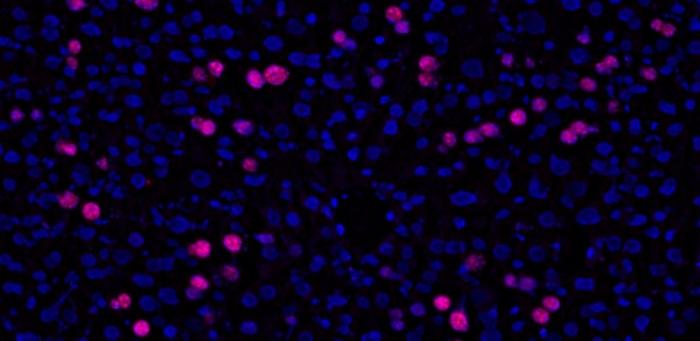
Hepatocytes marked in red dividing during the liver regeneration process after HMB supplementation. Credit: Ana Laura Vieira da Silva
In the first phase, some molecular markers looked favorable but there was no significant difference in regeneration time; all the mice recovered their liver mass in about seven days. but the liver has good regenerative capacity. That led to the second stage of the experiment, testing the “quality” of the recovery. That involved subjecting the regenerated liver to a new injury, where there were clear differences between the groups. The animals that did not receive the beta-hydroxy-beta-methylbutyrate showed more cellular distress, structural changes, tissue damage, and lower metabolic performance than mice that received the supplement.
The authors believe mitochondria preservation was the key factor.
They also found the beneficial effects occurred even after supplementation was discontinued, which suggests a lasting effect on tissue conditioning.
Mice are not little people, only trial lawyers and anti-science activists try to suggest the results are applicable to humans, but the results are compelling.
Citation: A. L. Vieira-da-Silva, M. V. Esteca, F. A. Silva, et al., “Preoperative Beta-Hydroxy-Beta-Methyl-Butyrate Supplementation Reduces Mitochondrial Dynamics Proteins and Preserves Hepatic Mitochondrial Function After Partial Hepatectomy in Mice,” Acta Physiologica242, no. 5 (2026): e70204, 10.1111/apha.70204