All living great apes laugh, and of course humans do as well. They share its rhythm in common and have for 15 million years, according to a recent study which analyzed laughter from four humans, four orangutans, four chimpanzees, three bonobos, and two gorillas and found the same pattern among all 140 laughter sequences; evenly spaced rhythmic intervals between successive sounds.
It's speculation at this point by psychologists involved say that similar laughs are evidence for how humans evolved to speak. One distinction is that though the basic rhythm stayed constant, human laughter has become faster, more variable, and with far greater context-dependent control. We control when and how we laugh, an uncontrollable laugh just sitting in a chair is a pathology but being tickled is socially acceptable. Bonobos don't have infectious laughter the way a group of friends do. That vocal control is also a fundamental building block of speech.
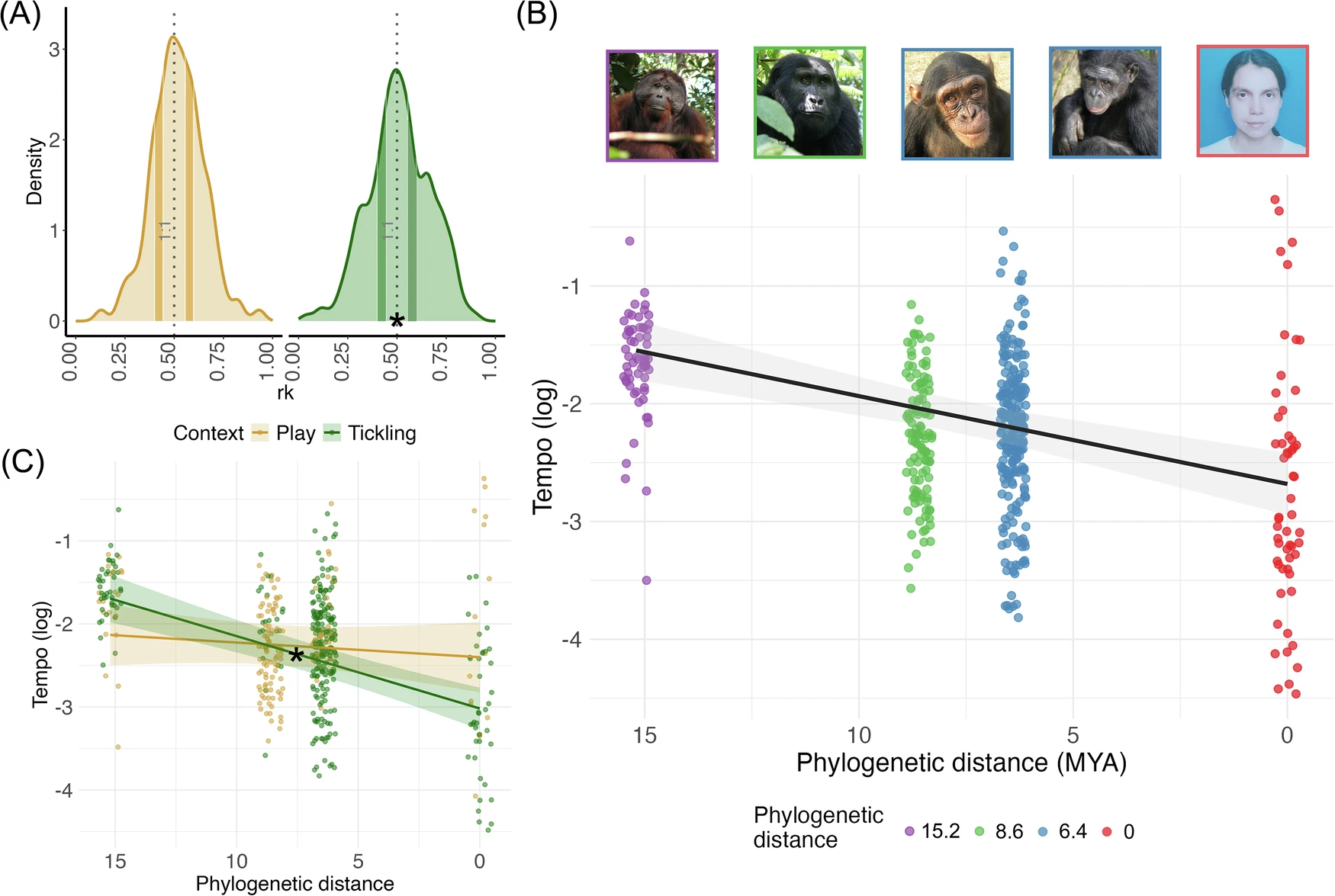
A Probability density function of rhythm ratios (rk) in the two behavioral contexts (play, in yellow, and tickling in green) derived from 140 laughter bouts across 17 individuals. White lines highlight on‑integer (0.440 < rk < 0.555, lighter shade) and off‑integer (0.400 <rk < 0.440 and 0.555 < rk < 0.600, darker shade) ratio ranges. *Denotes p < 0.05, indicating a statistically significant correspondence between the empirical distribution and a small-integer rhythmic ratio category. B Variation in laughter tempo across species. Each dot represents an individual observation; color indicates phylogenetic distance (in million years ago, MYA). Each square contains an image of the corresponding species, with a matching dot color for intuitive reference. Credits to M. E. Hardus, M. Davila-Ross, E. Demuru. C Variation in laughter tempo across behavioral contexts (play, in yellow, and tickling in green). *Denotes p < 0.05. Sample sizes: n = 4 biologically independent animals for orangutans, n = 2 for gorillas, n = 3 for bonobos, n = 4 for chimpanzees, and n = 4 children.
Psychologist Dr. Adriano Lameria of the University of Warwick said in a statement, “It is impossible to assess the precursor forms of language directly from our extinct ancestors. Laughter, being evolutionarily older and having remained shared between all living great apes, provides a rare evolutionary window into the vocal transformations that unfolded across hominid evolution until the first humans appeared on scene. Contrary to the classic notion that the first humans suddenly acquired vocal control capacities remarkably different from their predecessors, laughter evolution tells us that humans lay on a continuum, a prolongation of vocal control capacities that were already being cumulatively honed in for 15 million years."
Citation: De Gregorio, C., Davila-Ross, M. & Lameira, A.R. Rhythm and timing in laughter reveal that human vocal plasticity falls on a hominid continuum. Commun Biol 9, 824 (2026). DOI:10.1038/s42003-026-10499-z