Mesopotamia is Greek for “land between rivers” and indeed it sat between the Tigris and Euphrates rivers, what is now basically modern Iraq. Nearly everything we know about Mesopotoma is via Greece, the same way the local people living in America had no written language, so it was up to Europeans and then Americans to document stories they told, and in both cases science eventually ferrets out a deeper truth.(1)
In the case of Mesopotamia, the deeper truth is why agriculture became dominant there first - and with it, civilization. Using modern techniques, the two rivers can be inferred into the past, which means we can infer how the modern human world came to be.
Millions of years ago, climate change and tectonic plates caused the the Mediterranean Sea to become saline. There are still salt deposits from that time in areas as disparate as Israel and Turkey. What has been missing is a river that could have deposited them.
The new study used satellite data and seismic imaging to examine buried materials from that ancient time. The results lead them to suggest there were two ancient rivers then as well, at least one of them larger than the Nile.
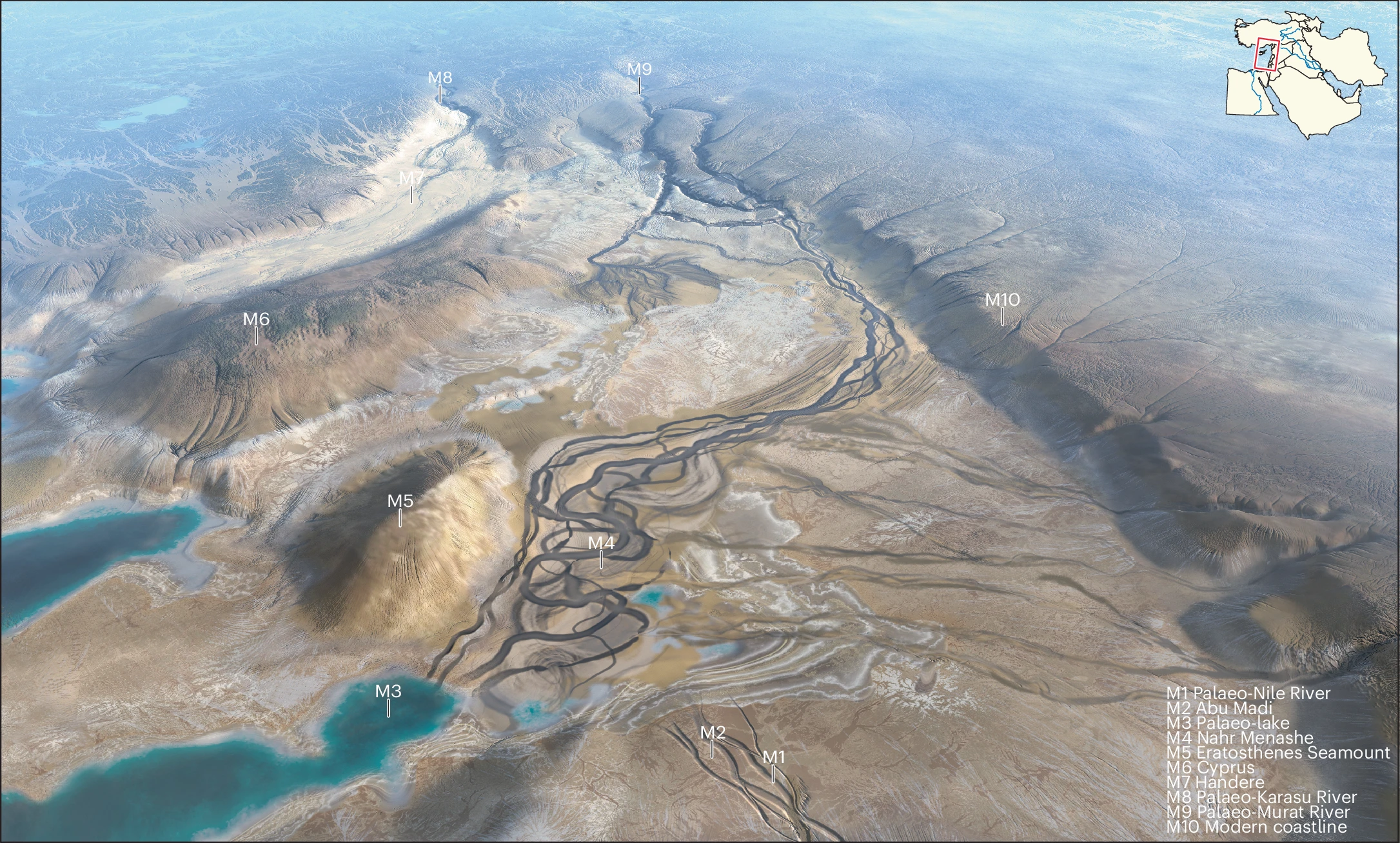
View to the north-northeast at ~200-km altitude showing partial basin-wide desiccation at ~5.35 Ma. The Handere was deposited north of Cyprus, whereas the Nahr Menashe and Abu Madi accumulated south of the Eratosthenes Seamount. Note the proximity of the Palaeo-Euphrates and Palaeo-Nile rivers. The palaeogeographic model integrates published data and this study to constrain onshore–offshore palaeo-elevations21,41 and delineate facies6,7,12,13,42. Inset map created in ArcGIS Pro 3.0.2 with data from Google. Credit: reconstruction, Lina Jakaitė and Andrew S. Madof
Then, around 1.5 million years ago, when Homo erectus walked out of Africa and Dire Wolves roamed America, tectonic plates had shifted enough that those prehistoric rivers changed course, from the Meditteranean to the Persian Gulf, leaving behind eons of salt deposits but eventually creating the Fertile Crescent.
An area so rich is made farming possible, leaving the nomad life behind, which ignited the fire of culture.
Citation: Madof, A.S., Laugier, F.J., Baumgardner, S.E. et al. Late Miocene Euphrates River drained into a partially desiccated eastern Mediterranean. Nat. Geosci. 19, 723–731 (2026). 10.1038/s41561-026-01962-x
NOTES:
(1) In America, rather being peaceful and living in harmony with nature, as just-so stories claimed, science showed that there were 900 tribes a few hundred years before Europeans arrived - not just the few on their maps now. The rest were eliminated due to conquest and colonization, just like Eurooe did in the Americas and what natives did to each other in Europe to create those modern countries.