Mesothelioma should be a disease of the past. Lawyers have made fortunes targeting asbestos, a flame protector used in buildings across the country. Despite its prevalence, mesothelioma remained a rare cancer. Most cancers take time to develop so that cases persist should be no surprise but after decades they should have begun to decline. Instead, they have gone up.
A new epidemiology paper tracked mesothelioma incidence and mortality across all 50 states from 1990 to 2023 and finds that rates have declined by a third - if the only metric is age‑standardized incidence and mortality rates.
Yet actual diagnoses have gone up 30 percent so if it isn't due to lawyers paying doctors to give out diagnoses, something does not add up. Disability‑adjusted life years are also 14 percent higher since 1990. There are othert confounders, which is why epidemiology is only EXPLORATORY, not settled science. Though incidence and mortality rates fell among men, that would make sense due to declines in asbestos use in shipbuilding, construction and insulation work. But female incidence increased in 20 states, and female mortality rose in 18 states.
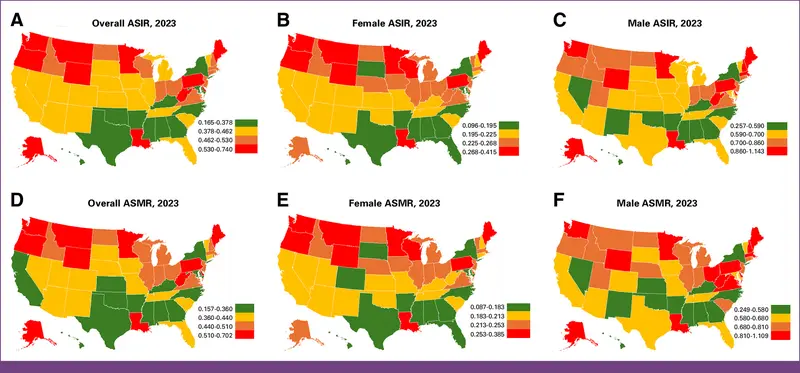
State-level ASIR and ASMR, stratified by sex, 2023: (A) overall ASIR, (B) female ASIR, (C) male ASIR, (D) overall ASMR, (E) female ASMR, and (F) male ASMR. ASIR, age-standardized incidence rate; ASMR, age-standardized mortality rate; MIR, mortality-to-incidence ratio.
Which makes no sense. It requires believing in homeopathic mechanisms for exposure in "contributing" claims, about 96 percent still claim occupational asbestos exposure. Maine, Alaska, Washington and Minnesota have little in common, yet have high mesothelioma, which means there needs to be uncritical links for shipbuilding, natural exposure, and iron mining. And then men returned home and fibers impacted women, despite protective measures in place for half a century.
One thing that has not changed is the mortality-to-incidence ratio. Survival remains low, hovering near 1, which means that most people diagnosed with mesothelioma still die from it, and lawsuit settlements have not led to funding boosts for research. Immune checkpoint inhibitors have entered clinical practice but their impact has not yet shifted outcomes.
Citation: Kyle Edwards, Chinmay T. Jani, Kyle Rowley, Jeeya Patel, Dominic Marshall, Coral Olazagasti, Gilberto Lope, Estelamari Rodriguez, 'Geographic, Temporal, and Sex-Specific Trends in Mesothelioma Burden in the United States, 1990–2023', JCO Glob Oncol 12, e2600056(2026), Volume 12, Number 6, DOI: 10.1200/GO-26-00056