One enduring myth about the collapse of the Roman Empire was that barbarians - Pagans from the north and Muslims from the south - caused it.
The real cause was weather. Some 1600 years ago climate shifts made life much harder to sustain and the Roman Empire became unable to feed itself. The evidence for its total impact is that whether the replacements were farmers or nomads, food production overall did not increase. The so-called barbarians moved in and instead shaped Roman culture, a precursor to the American melting pot.
A new paper used ancient DNA analyses of more than 300 individuals who lived in the Little Hungarian Plain, an area in northwestern Hungary, with archaeological finds.
The science affirms the archeological belief about the expansion of the Lombards from north of the Danube River into former Roman territories during the early sixth century. The new melting pot communities were not just loose rural settlements, they created a diverse, hierarchical new society consisting of ruling elites forging a new post-Roman polity.
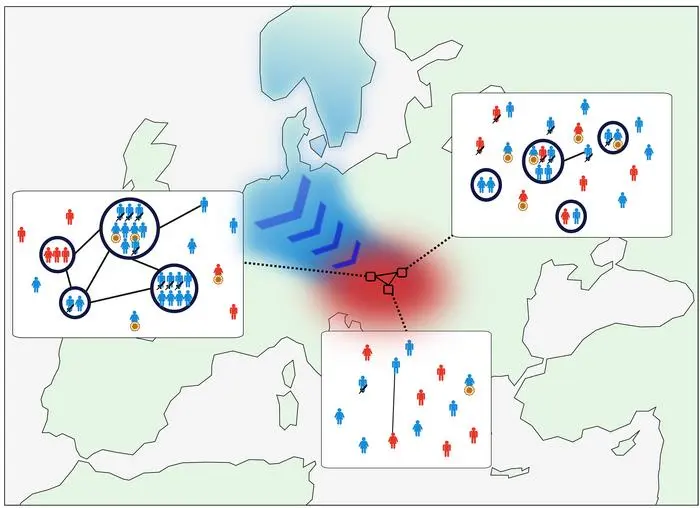
The formation of differing forms of sixth-century communities through the convergence of migrating Northern European (blue) and local Southern European (red) ancestry. By combining ancient DNA, isotopic data, and archaeological data, we are able to reconstruct the emergence of complex regional hierarchies in the post-Roman world. Credit: HistoGenes
Since the barbarians left few written records, history was instead written by the losers. Science can reveal a deeper story. At least in the case of the Little Hungarian Plain, migrating Lombards became the ruling power but Roman culture changed them as well. Even today, northern Italy and the central and south remain drastically different, even though to most people they are considered the same.
Citation: Yijie Tian, István Koncz, Norbert Faragó, Corina Knipper, Ronny, Deven N. Vyas, Levente Samu, Olga Spekker, Tamás Szeniczey, Tamás Hajdu, Balázs Gusztáv Mende, Péter Tomka, Ildikó Katalin Pap, Dávid Czigány, Rita Radzeviciute, Luca Traverso, Guido Alberto Gnecchi-Ruscone, Paolo Francalacci, Bernd Schöne, Gábor Tóth, Anna Szécsényi-Nagy, Petrus le Roux, Kurt W. Alt, Zuzana Hofmanová, Walter Pohl, Johannes Krause, Tivadar Vida, Patrick J. Geary, and Krishna R. Veeramah, 'Unveiling the complexity of post-Roman polity formation in Pannonia using ancient DNA', Science, 11 Jun 2026, Vol 392, Issue 6803, DOI: 10.1126/science.aec2634